
Compliment: Rejected. Case Closed.


Thank you.
Two little words that require very little thought really. Two little words that should be toggled on as the default auto-response when someone offers you a compliment. Simple, requiring minimal effort.
So why is it that when someone takes the time to throw a compliment in our direction we present a prepared dissertation letting them know why whatever it is they took the time to compliment is, actually, not that great. Someone says your hair looks great? Not so fast….it can’t possibly look great because “Ugh, I was lazy and didn’t wash it.” Like they need to rethink their compliment now that they are fully informed.
I am one of the “we”. This is close to word for word what happens every single time someone says something nice to me. "Love that top." I found it on the clearance rack. "Your house looks so good." Don't open any of the closets, it's a disaster behind every door. "You look great today." Ugh, I am exhausted, my makeup must be hiding a lot. Something, anything, to make sure the compliment doesn't land before I've had a chance to diminish it first.
I don’t have the exact ratio, but rest assured, that the number of times I have just said thank you and left it alone vs. presenting my case to prove the compliment wrong is very low.
If you just read that and felt a small, specific wince of recognition, welcome.
Two things to know: 1. You're not broken and 2. You're not being humble. Research shows that you're doing something your brain has been trained to do for years.
Which I find weirdly comforting. I mean, at least I'm not making this up.
the mismatch
Self-verification theory: that is what psychologists have named part of what's happening here. The short version is that your brain prizes consistency over compliments. If the story you carry about yourself is "fine, but nothing special," a compliment doesn't register as a gift. It registers as a fact that doesn't match your own records, and your brain would rather correct the record than update it.
A study published in the Journal of Personality and Social Psychology looked at exactly this. People with lower self-esteem feel genuine discomfort receiving compliments from the people closest to them. Not because they doubt the other person's kindness. Because the praise doesn't line up with how they already see themselves, and that disagreement feels like something they need to manage rather than something to enjoy.
You want to know the part I actually found useful? The same researchers found that the discomfort dropped when people focused on the specific thing being praised instead of what it supposedly said about them as a whole person. Specific is easier to believe than general. "That color looks great on you" is an easier thing to accept than "you're beautiful," because the second one is asking you to agree with an entire verdict about yourself, not just a fact about a shirt.
Every time someone's nice to you, your brain pulls out a t-chart and starts working. Your nervous system compares the compliment to what it already believes, and more often than not, the lists don't match.
the deflection has a job
Words have power, even the ones that roll off your tongue without a second of hesitation in an effort to appear humble.
"Oh, I got it on clearance" does actual work in that split second. It quickly corrects the record before anyone gets the wrong idea about me. It manages the moment instead of just letting me stand in it. "It's driving me crazy" does the same thing from the opposite direction. Someone compliments something I'm secretly annoyed by, and instead of just saying thank you, I hand them my complaint file. They just wanted to let me know what they admired about me, and before they know it they have been dragged into what feels like a debate about why their admiration is misdirected.
And "it's no big deal" might be the sneakiest one of all, because it sounds modest and isn't. It's a tiny, automatic vote against your own good thing happening, cast with such automaticity you don't even feel yourself casting it.
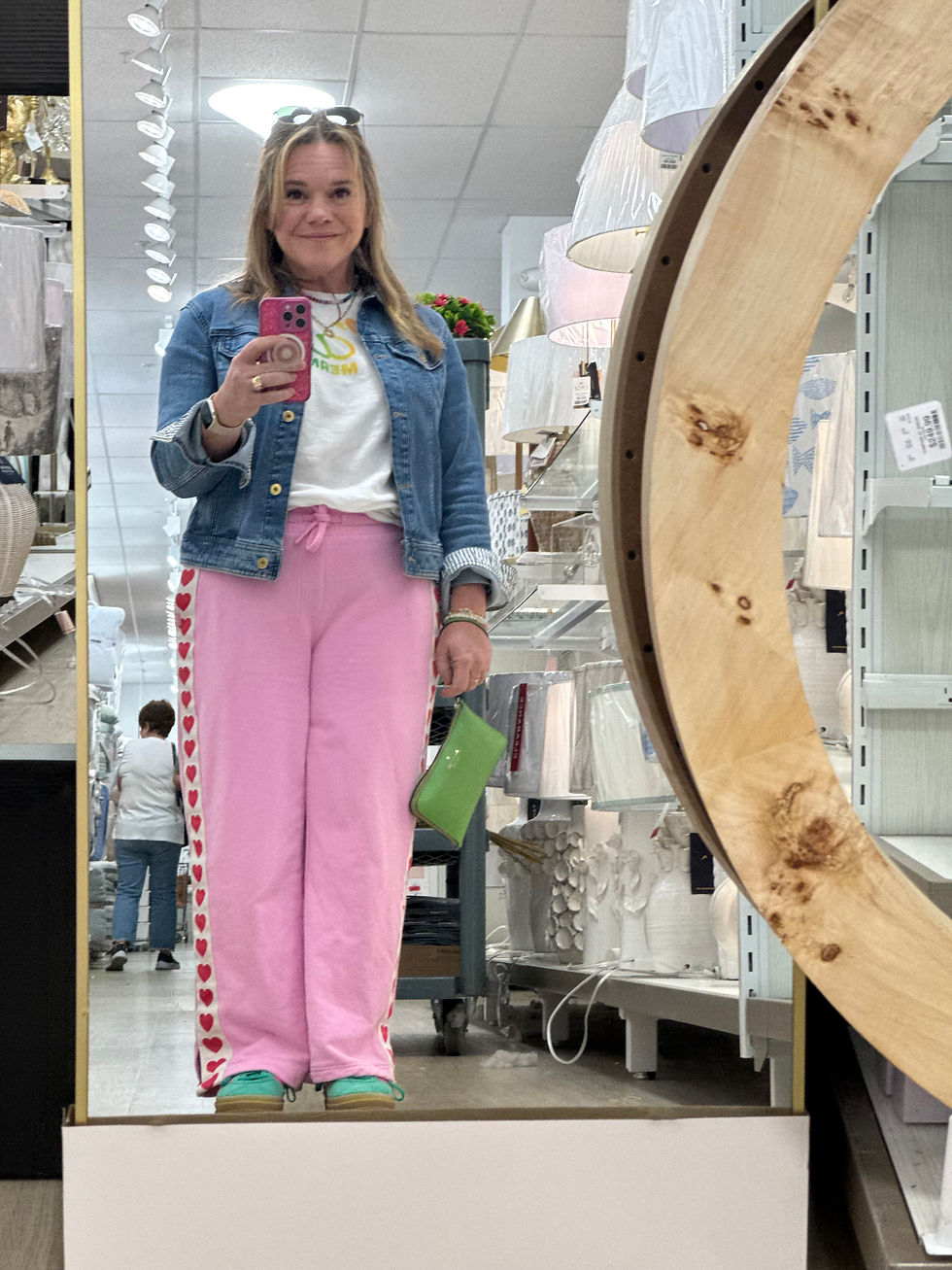
The thing about me is that when I catch myself doing something like this I need to know why. Turns out, like most things, it is your brain adapting to “protect you”. If you grew up anywhere near the message that taking up space or sounding pleased with yourself was a little much (hello 99.9% of humans who identify as females, especially those of us in midlife), deflecting became the polite version of disappearing. Small, automatic, socially acceptable. Nobody claps when you deflect a compliment well. Nobody's even supposed to notice. Mission accomplished, every time, for years.
what it adds up to
One deflected compliment doesn't cost you anything. That's true, and it's also the trick. It's never one. It's the sale tag and the messy closet and the bad lighting and the haircut complaint, repeated so many times across so many years that the pattern becomes invisible. You stop noticing you're doing it.
The other thing that you are not noticing is that the compliments never get the chance to land anywhere. Think of each of those compliments as a drop of rain, and when you allow them to land they soak in and feed your soul a little. If you are always deflecting, you are missing out on that nourishment.
Now, before your brain chimes in…no, it isn’t vain, conceited, or boastful to simply say thank you when someone offers you a compliment. Think of a compliment as a gift someone is offering you. You wouldn’t hand a gift back with all the reasons you don’t deserve it, would you? (please tell me you said no)
Since recognizing my own tendency to deflect compliments, I have made an effort to be more aware of my reaction when offered a compliment. Turns out taking a compliment without the rebuttal is harder than it sounds. I really have to get ahead of the deflection auto-response to keep it from slipping out.
what thank you actually costs
Not much, it turns out. That's the annoying part.
I gave myself one day of just catching the deflection mid-sentence and stopping. Mid-haircut-complaint. Mid-sale-tag-confession. Mid-"it's probably the lighting." And just not finishing the sentence the old way.
It felt strange almost every single time. A little exposed, like I'd left a door open that I usually keep shut out of habit. Nobody else noticed. Nobody clapped, nobody commented, nobody even registered that anything had happened differently. Which, again, tells you exactly how small this actually is and how big it's felt inside my own head for decades.

I'm not telling you to go fish for compliments or post something captioned "accepting all positive feedback today, thanks in advance." That's not the invitation. The invitation is smaller than that. The next time someone says something nice and true, pause, take two full breaths (quietly, don’t make it weird), let it soak into your soul before your mouth starts managing it. See what happens. Probably nothing dramatic. Oh yeah, don’t forget to say thank you. Manners, after all.
start smaller than that, if you need to
If even one day of this feels like too much right now, start with the free Radiant Day Starter Kit instead. It's five minutes, not a personality overhaul, built around the same idea as everything above: small, specific things, done on purpose, instead of waiting until you feel ready for the bigger version. Grab it here.
Everything else will still be here when you are.
So tell me the line you reach for. The sale tag, the bad lighting, the "it's nothing," whatever yours is. I have a feeling a lot of us are running the exact same script, word for word.


Comments