
The Graveyard of Good Intentions
- Christine Spencer

- Jul 20
- 7 min read

January 1st, 19 or 20 something.
You have your brand new water bottle, filled with 64 ounces of water that you have promised yourself you are going to consume and refill at least three times every single day. You crack open that amazing new organizer — the one that is finally going to help you get your shit together — and spend the next three hours filling in every detail.
You. Are. Ready.
February 9th, same year. You forgot how dreadfully forgetful you are, so you've found the perfect solution. An app that will remind you every time you need to make a move to do the thing. There's no way you are going to forget now.
April 1st, same year. Who are you trying to kid. You silenced that app approximately eleven minutes after it first went off and never heard from it again. Then you worked through some of the frustration in the five most perfect journal entries you have ever written, entries that you just knew would help you work through the baggage that was clearly keeping you from moving forward.
That summer came the course that was so interesting to watch. You absolutely killed module one. But then you went to the beach and decided it was entirely too hot to figure any of this out, and maybe in the fall.
Sound familiar?

Your Graveyard
Too real? I get it. I have one too — that graveyard of systems and fixes that each convinced me, in turn, that they were the magic key to finally figuring out what was going on with me.
Now to be clear: I wasn't trying to organize anything or plan anything or streamline a workflow. I am a Virgo. Organization I've got. What I was trying to do was fix something I couldn't quite name yet — a restlessness, a numbness, a growing sense that something had quietly gone sideways and I didn't know how or when. I didn't know what it was exactly, but I was absolutely going to find a product that fixed it.
First: the most aesthetic, highest-rated daily practice system I could find. January 1st, full conviction. It kept my appointments in line, but the other 75 spaces that needed filling each day stopped happening right around February 9th. Clearly I was a defective Virgo.

Next: a course that was supposed to address the feelings of career unrest. Two modules completed flawlessly. The rest left undone, because at some point the voice in my head had decided that there was no way I would ever be able to earn a consistent income without working for someone else. Who did I think I was, exactly?
The rest of the graveyard is a familiar landscape — personal development books with one to four chapters read, journals with a solid week of entries and then silence, 30-day challenges with the first seven days completed flawlessly and the rest forgotten.
And here's the thing I want you to understand about that graveyard. I didn't buy all of those things at once on some wild shopping spree. Each one was purchased separately, with an enormous amount of hope and a little desperation, that this would be it. The thing that brought me back — back to the joy, back to the sparkle, back to the laughter, back to just feeling something.
And when they didn't work, my brain didn't think about why they weren't a good fit. It went straight to the failure file. Not organized enough. Didn't try hard enough. Doesn't stick with anything long enough. Clearly I just couldn't get my shit together.
Since 2018 that story kept reinforcing itself — that I didn't have the follow-through to be a business owner, that leaving teaching wouldn't happen because I couldn't stay with anything long enough to make it real.
Remember that voice from last week? She was the one doing the filing.
The Reframe
Turns out, it wasn't me. It was the tools.
And listen when I tell you — it's not you either.
I'm not here to tear down anyone else's product, because that's not what we do here. But most of these tools are like denim from the 80s: 100% cotton, 0% spandex, and exactly zero hope that they were going to fit you unless your body happened to be the exact shape they were designed for. The products aren't bad. They're just not designed for the specific kind of disruption that happens as you move into midlife.

Most daily practices, guided journals, and productivity systems were built for someone with unlimited time, consistent energy, and no competing demands on either. That person doesn't exist. She especially doesn't exist in midlife, when your capacity fluctuates daily and the cognitive load of simply managing your own life is already significant before you've added a single aspirational habit to the pile.
Wrong tool. Wrong fit. Not a character flaw.
What Actually Happened
Everything we're told about getting older suggests that with age comes wisdom, and with wisdom should come mastery. We should be killing it at this life thing by now.
So why does it suddenly feel like we're on a pendulum — power-cleaning the entire house in four hours one Tuesday and unable to fold the single load of laundry sitting on the dryer for three days the next? Why does the same brain that once kept track of professional obligations, meal plans, sports schedules, vacation logistics, and multiple other humans' needs now seem to genuinely struggle to keep track of its own schedule?
Here's what's actually happening, and it has nothing to do with discipline.
Hormonal fluctuation during perimenopause directly affects executive function, working memory, and motivation — the exact combination of cognitive tools required to follow through on any kind of daily system. Estrogen doesn't just affect how you feel. It affects how your brain processes information, how well you can hold a plan in your head, and how much energy is available for tasks that require sustained effort. When estrogen fluctuates, all of those things fluctuate with it. Not because you got lazy. Because your biology changed and nobody mentioned it.
Traditional productivity tools were designed for linear, consistent performance — the assumption that you'll show up with roughly the same capacity every day and simply apply discipline to fill in the blanks. Midlife doesn't work that way. A system that requires Monica Geller energy every single day will fail any woman who has a Tuesday where she has almost nothing left to give. And then — this is the particularly cruel part — when motivation returns, she looks back at how well she did the week she had more energy, decides she should be able to sustain that level, and uses the gap as evidence against herself.
Trying harder with the same broken tool doesn't work. It just makes the failure file thicker.

What Changes Things
I would be lying if I said I don't have big goals. Wanting things, working toward something, building toward a life that feels like yours — that's a human feature worth keeping. But somewhere in midlife, a lot of us start quietly turning the volume down on those goals, a little each year, until we've talked ourselves into something smaller and safer without fully realizing we did it. We begin to quiet ourselves.
There are a million societal reasons for that, and unpacking all of them would take miles of bunny trails we'll save for another day. What I can tell you right now is this: we are not sitting here blaming ourselves. We are adapting our systems to accommodate the new wiring of our bodies.
What that looks like in practice is not a bigger, more comprehensive system. It's a smaller one. Built for where you actually are — not where a productivity influencer assumes you should be.
There's an idea that shows up in both ancient contemplative practice and modern behavioral research that I kept coming back to while building The Shine System™: when everything around you is changing — and in midlife, everything is — a consistent daily practice becomes the ground you stand on. Not because it fixes the change, but because it doesn't change. You control the ritual. The ritual becomes the anchor. The science backs this up too: repeating a small consistent practice at the same time and in the same way reduces the cognitive load required to do it, because it stops being a decision and starts being simply what you do. The brain stops spending energy on whether to do it and can put that energy toward actually doing it.
That's what I needed. Something that required just enough on the days when I had almost nothing left — because a little really does become a lot over time, and showing up imperfectly on a hard day counts more than not showing up at all on a day that was waiting for perfect conditions. On the days when I was running at full Monica Geller capacity, I also needed something flexible enough that I wasn't building a high-performance record I'd use to gaslight myself the following week when motivation had quietly packed its bags.
I built The Shine System™ because that thing didn't exist yet. It starts with who you want to be, not how much you need to get done. It's undated and flexible, because real life isn't either of those things. It's designed for the inconsistency midlife actually brings — not despite it — and it gives you somewhere consistent to stand while everything else is moving.
The Graveyard isn't the Whole Story
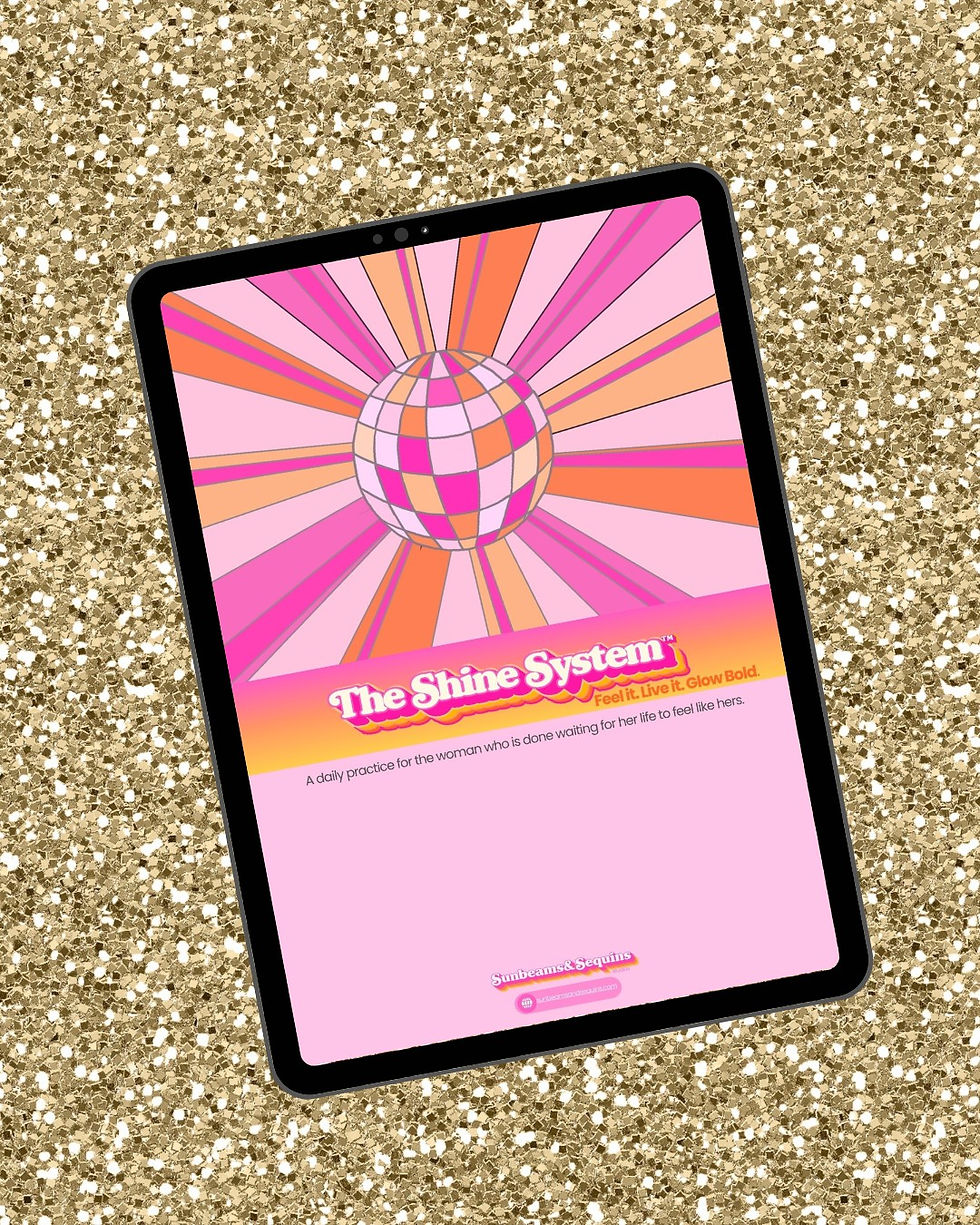
The graveyard of good intentions isn't evidence that you can't. It's evidence that nothing was built for where you actually were.
That changes now.
The Shine System™ is linked here if you want to take a look. No pressure, no pitch — just a daily practice built by someone who needed it herself and couldn't find it anywhere else.
And tell me: what's in your graveyard? The specific things — the apps, the journals, the courses, the challenges. Name them. What did you tell yourself when they didn't work?
I'll go first in the comments below. ✨


Comments